Thailand is famously welcoming, and visitors are forgiven most mistakes made with a smile. Still, a little knowledge of Thai culture etiquette transforms how people respond to you: doors open, conversations warm up, and you stop worrying about accidentally offending someone. Thai manners are built on a few deep values — respect for elders and teachers, harmony in the group, and the concept of “kreng jai,” a reluctance to impose on others. Once you understand those roots, the individual customs below stop looking like random rules and start making intuitive sense.
The Wai and the Language of Respect
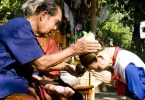
The wai — palms pressed together with a slight bow — is Thailand’s signature gesture of respect, greeting, thanks, and apology. As a visitor, you do not need to initiate wais with everyone; generally, you return a wai offered to you, except from children and service staff, whom you acknowledge with a smile and nod instead. The height of the hands and depth of the bow scale with the other person’s status: hands at chest level for peers, at nose level for elders and teachers, and higher for monks. Getting this roughly right signals immediately that you understand Thai culture etiquette at more than a tourist level.
Closely related is the respect shown to the head and feet. The head is considered the most sacred part of the body, so never touch a Thai person’s head, even a child’s, and avoid stepping over anyone sitting on the floor. Feet are the lowest and least clean, so never point your feet at a person, a Buddha image, or a monk, and take care when crossing your legs in formal settings. These two rules — head high, feet low — prevent the majority of accidental offenses.
Temples, Monks, and Buddha Images
Buddhism shapes daily life in Thailand, and temples are community centers as much as religious sites. Dress modestly when visiting: shoulders and knees covered, shoes removed before entering buildings. Women should never touch a monk or hand objects directly to him; place the item down for him to pick up. Buddha images are sacred regardless of size or age — do not climb on statues for photos, do not place Buddha souvenirs on the floor, and export of certain Buddha images is even regulated by law.
Inside a temple, sit with your feet tucked to the side or behind you, never stretched toward the altar. Speak quietly, ask before photographing ceremonies, and consider a small donation in the box provided. Visitors who follow these basics are welcomed warmly by temple communities, and many find a morning visit — when monks chant and locals bring food offerings — to be the most memorable cultural experience of their trip.
Respect for the Monarchy
Thailand’s reverence for the royal family is deep and sincere, and it is also protected by strict law. Visitors should never criticize, joke about, or mock the monarchy in any setting, public or private, online or offline. Practical expressions of this respect include standing for the royal anthem, which plays in cinemas before films and in public places at 8 a.m. and 6 p.m. for the national anthem, and treating banknotes — which bear the king’s image — with care. Never step on a dropped coin or note to stop it rolling away; pick it up with your hand instead.
This is one area where ignorance is genuinely risky rather than merely embarrassing, so treat it seriously. When Thai friends talk about the royal family, listen respectfully and let them lead the conversation.
Everyday Manners: Kreng Jai in Action
“Kreng jai” explains many everyday behaviors: refusing a first offer of food even when hungry, speaking indirectly to avoid embarrassment, and never raising one’s voice in disagreement. Public anger is a serious loss of face in Thailand — the person who shouts loses, regardless of who is right. If something goes wrong, a calm voice and a smile resolve problems faster than any complaint. This preference for harmony also means “yes” sometimes means “I hear you” rather than agreement, so confirm important arrangements politely and in writing when it matters.
At the table, meals are shared: dishes go in the middle, you take a few spoonfuls at a time onto your rice, and the person who invites usually pays — splitting bills among close friends is common among younger Thais but the host-pays custom remains the default in formal settings. Using a spoon in your right hand and fork to push food onto it (knives rarely appear) marks you as someone who has paid attention. Shoes come off when entering homes and many small shops; if you see a row of shoes at a doorway, follow the local lead.
Understanding local customs also colors how you experience Thai entertainment and media. Programming, festivals, and even online content follow the same values of respect and community. You can see the lighter side of Thai digital culture in the variety of content Thais consume, from learning platforms discussed in our overview of online entertainment options to the relaxation habits in our piece on gaming as stress relief — leisure, like everything else, is social here.
Small Gestures, Big Returns
The beautiful secret of Thai culture etiquette is how generously effort is rewarded. Learning to wai correctly, greeting elders first, dressing neatly for temples, and keeping your cool in a mix-up will earn you patience, help, and invitations that money cannot buy. Thais do not expect foreigners to be perfect; they notice intention. Approach each situation by asking “Who should be honored here, and how do I avoid imposing?” and you will navigate almost everything gracefully. Etiquette, in the end, is simply empathy made visible — and in Thailand, it is noticed and remembered.
A practical way to deepen all of this is to pair etiquette with observation: spend an afternoon in a temple community or a local market simply watching how people greet, queue, bargain, and thank one another. Ten minutes of real observation teaches more about kreng jai than a chapter of rules. Then practice one new gesture at a time until it becomes yours — etiquette learned this way stays with you long after the trip ends.